GPT-6.1 Sol API Pricing: Same $2/$10 as Sol, Cached Input Halved
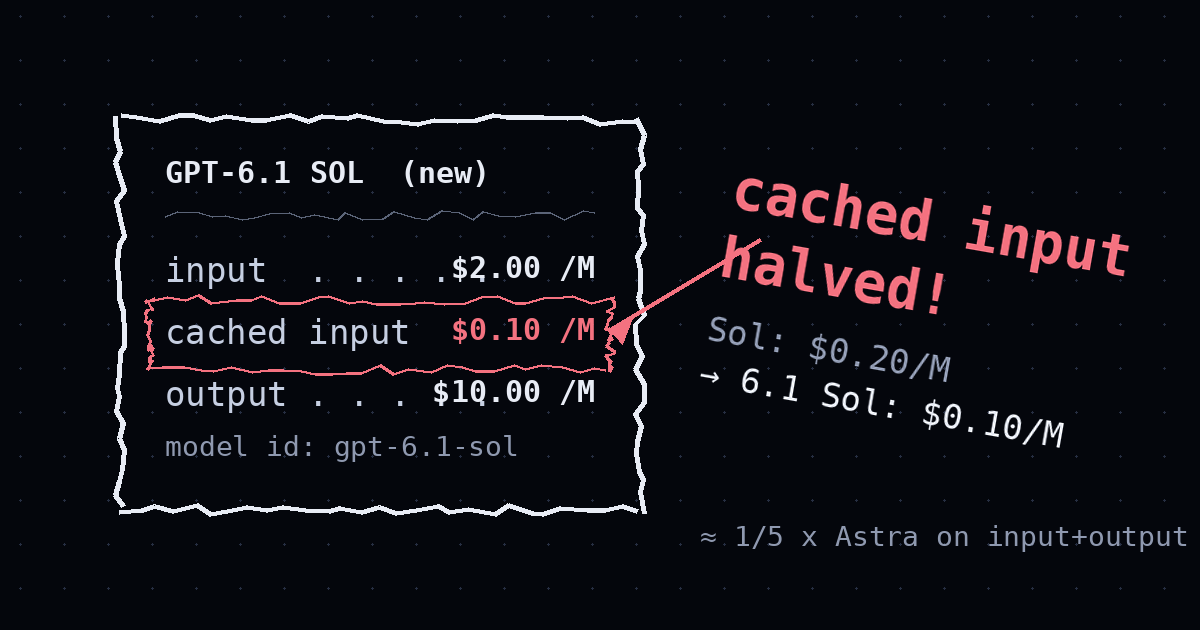
Short answer: OpenAI launched GPT-6.1 Sol at DevDay 2026 on September 29, and the headline rates are identical to GPT-6 Sol — $2.00 input, $10.00 output per million tokens on the standard tier. The one price that moved is cached input: $0.10/M instead of Sol's $0.20/M, a clean 50% cut. If your workload barely caches, your bill doesn't change. If it caches a lot, 6.1 Sol is a free downgrade in price for what OpenAI calls "near-Astra performance."
Published September 30, 2026 · Pricing verified September 30, 2026
What OpenAI announced
GPT-6.1 Sol shipped in the API on launch day as gpt-6.1-sol, also available in ChatGPT Work and Codex for Plus, Pro, Business, Enterprise, and Edu users. OpenAI's positioning, in its own words, is "near-Astra performance for complex work at a lower cost" — specifically "a fifth of [Astra's] standard input and output token prices." The family table, as listed on OpenAI's pricing page, now reads:
| Model | Input /M | Cached input /M | Output /M |
|---|---|---|---|
| GPT-6 Astra | $10.00 | $1.00 | $50.00 |
| GPT-6.1 Sol | $2.00 | $0.10 | $10.00 |
| GPT-6 Sol | $2.00 | $0.20 | $10.00 |
| GPT-6 Luna | $0.10 | $0.01 | $0.50 |
Everything else matches Sol: a 1,050,000-token context window and 128K max output tokens. The "1/5 of Astra" claim checks out exactly on input and output ($2 vs $10, $10 vs $50); on cached input it's actually 1/10 ($0.10 vs $1.00). Prices verified September 30, 2026 — always confirm on the official pricing page.
The only number that changed — and who it pays
Prompt caching is where the two Sols diverge, so the savings are a direct function of your cache hit rate. At 0% caching, the models bill identically. The math below is an illustrative scenario, not an industry average: 50K input tokens per request at 80% cached, 5K output, 100K requests/month, standard tier.
On that scenario, Sol bills $7,800/month; 6.1 Sol bills $7,400/month — a $400/month saving, or 5.1%, all of it from the cached-input line. A second illustrative workload — 100M input tokens/month at 60% cached plus 20M output — puts 6.1 Sol at $286/month vs Sol at $292/month (~2% cheaper) vs Astra at $1,460/month (5.1× more). Against Astra, the new tier genuinely does what the headline says: roughly one-fifth of the bill for a workload that leans on output. (Your cache hit rate is your own number; run it through the calculator before switching.)
Same sticker as Claude Sonnet 5.5 — different cache math
The $2/$10 tier just got crowded. Anthropic launched Claude Sonnet 5.5 the day before (September 28) and kept Sonnet 5's rates exactly: $2.00 input, $10.00 output, $0.20 cache reads, $2.50 cache writes. So three models now share the same headline price, and the comparison comes down to the fine print:
- Cached input: 6.1 Sol at $0.10/M is half of Sonnet 5.5's $0.20/M cache-read rate — and half of GPT-6 Sol's $0.20/M.
- Cache writes: Anthropic surcharges cache writes at 1.25–2× base input ($2.50/M for Sonnet 5.5); OpenAI's pricing page lists no separate cache-write line for the GPT-6 family.
- Token efficiency: Anthropic's pitch for 5.5 is speed and fewer tokens per task rather than lower rates — which is a claim about your token counts, not your rate card. My cost comparison: how Anthropic's refusal billing can quietly move a Claude bill, and the Claude vs GPT-6 comparison with the current rates.
Should you switch from Sol?
If you're on GPT-6 Sol today, this is about as close to a no-brainer as model upgrades get: same input and output rates, half-price cached input, and OpenAI claims better performance. The one honest caveat is that "near-Astra performance" is OpenAI's claim on its own benchmarks (DeepSWE v1.1, Terminal-Bench Science) — verify it on your own evals before moving production traffic. Nobody outside OpenAI has had this model for 24 hours yet, myself included. The pricing part, though, is arithmetic, and the arithmetic favors 6.1 Sol for anything that caches.
Sources
Pricing: OpenAI API pricing (GPT-6.1 Sol row, read at launch). Launch details: CellCog's DevDay 2026 recap (September 29, 2026) and Securities.io's launch report. Sonnet 5.5 rates: multi-outlet launch coverage (September 28, 2026) reporting unchanged $2/$10 rates.
Plug your input/output tokens and caching into the calculator and see exactly where 6.1 Sol lands against Sol, Astra, and Claude.
Open the GPT-6 cost calculator