GPT-6 Astra vs Sol vs Luna: Which Tier Should You Use?
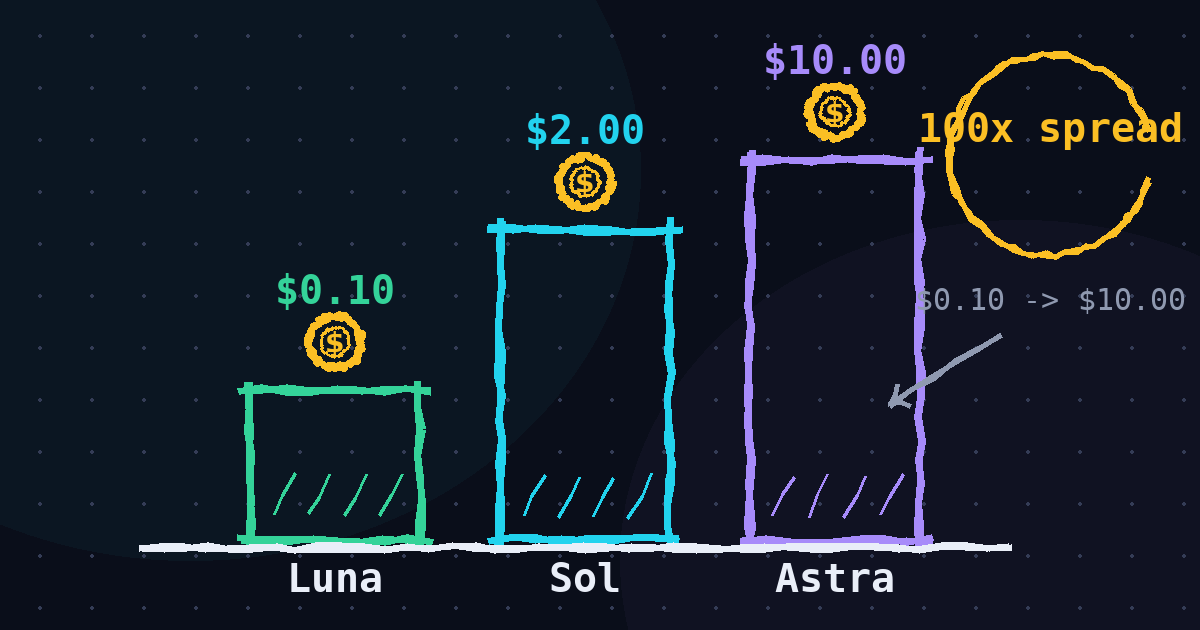
The entire GPT-6 tier decision fits in one sentence: Luna costs $0.10 per million input tokens, and Astra costs $10.00. That's a 100× spread between the cheapest and priciest way to call the same API family. Everything below is just helping you figure out where on that 100× ladder your workload actually belongs — because the answer most teams default to (Sol, the middle one, chosen purely on vibes) is usually wrong.
The pricing, side by side
Short-context Standard rates per 1M tokens. Ratios below compare the same token category; total savings depend on your workload mix.
| Tier | Input / 1M | Cached input / 1M | Output / 1M |
|---|---|---|---|
| Luna | $0.10 | $0.01 | $0.50 |
| Sol 6.1 (current) | $2.00 | $0.10 | $10.00 |
| Sol (previous) | $2.00 | $0.20 | $10.00 |
| Astra | $10.00 | $1.00 | $50.00 |
GPT-6.1 Sol replaced the previous Sol generation on September 29, 2026. Input and output rates are identical — the only price that moved is cached reads, halved from $0.20 to $0.10 per million. Prices verified October 1, 2026 — always confirm on the official pricing page before deciding.
What each tier is actually for
Luna — the "prove you need more" tier. $0.10 in / $0.50 out per million. Classification, extraction, translation, first-draft summaries, FAQ bots — the high-volume, well-scoped stuff. It's 95% cheaper for fresh input and output, and 90% cheaper for cached reads, than current Sol 6.1, which means the burden of proof should be on spending more, not less. If your evals pass on Luna, you're done, and you just saved yourself a meeting.
Sol 6.1 — the comfort-food tier. 20× Luna for fresh input and output, and 10× for cached reads; one-fifth of Astra for fresh input and output, and one-tenth for cached reads. Agentic workflows, code generation, the tasks where you genuinely want the stronger model. No shame in it — just make Sol audition on your evals instead of handing it the job on vibes. "Middle" is not a strategy. (The previous Sol generation priced identically except cached reads at $0.20/1M — see the current vs previous Sol comparison.)
Astra — the scalpel. 5× current Sol 6.1 for fresh input and output, and 10× for cached reads, $50 per million output tokens. This is the tier for the 1% of calls where a wrong answer costs real money. If you're sending everything to Astra, you're either a bank or you haven't done the routing work yet. (No judgment. Do the routing work.)
A decision framework that fits on an index card
- Start on Luna. No, really. Prototype on the cheapest tier first. If quality clears your bar, ship it — your token rates are 95% lower for fresh input and output, and 90% lower for cached reads, than current Sol 6.1.
- Make Sol audition. Run the same eval set on Luna and Sol. Where Luna fails on reasoning-heavy cases, those specific cases go to Sol. Not the whole workload — the failing slice.
- Reserve Astra for the critical subset. Even teams that genuinely need Astra rarely need it for every request. Route the high-stakes calls there and keep everything else down the ladder.
- Revisit quarterly. Models get better, prices move, and the tier that was right in January can be wrong by June. Put it on the calendar — future you is already busy.
Worked example: 1M requests/month
Concrete numbers make this visceral. Say each request uses 1,500 input tokens and 400 output tokens — 1.5B input + 0.4B output tokens a month:
- All Luna: 1,500 × $0.10 + 400 × $0.50 = $350/mo
- All Sol (6.1): 1,500 × $2.00 + 400 × $10.00 = $7,000/mo
- All Astra: 1,500 × $10.00 + 400 × $50.00 = $35,000/mo
- Hybrid (80% Luna / 20% Sol): $1,680/mo — 76% cheaper than all-Sol
Stare at the gap between Luna and Astra for a second: $34,650 a month for the same request shape. That's a full-time engineer's salary, decided by a dropdown menu. The hybrid row is the punchline — cheap tier for the bulk, strong tier where it matters, $5,320 a month saved versus all-Sol.
The bottom line
Don't default to the middle out of habit. Benchmark Luna first, route selectively, and reserve Astra for what truly needs it. For most workloads the right answer is a mix — and now you know exactly what the mix is worth. Want the rest of the playbook? See our 10 ways to cut your GPT-6 bill.
Plug your request volume and token counts into the free calculator to see Astra vs Sol vs Luna side by side.
Open the calculator